For years we've been hearing the same phrase: "Data is the new oil." A nice metaphor, but it's misleading. Oil is a raw material that you extract, refine, and burn. Data is something different. Data is the foundation on which everything stands.
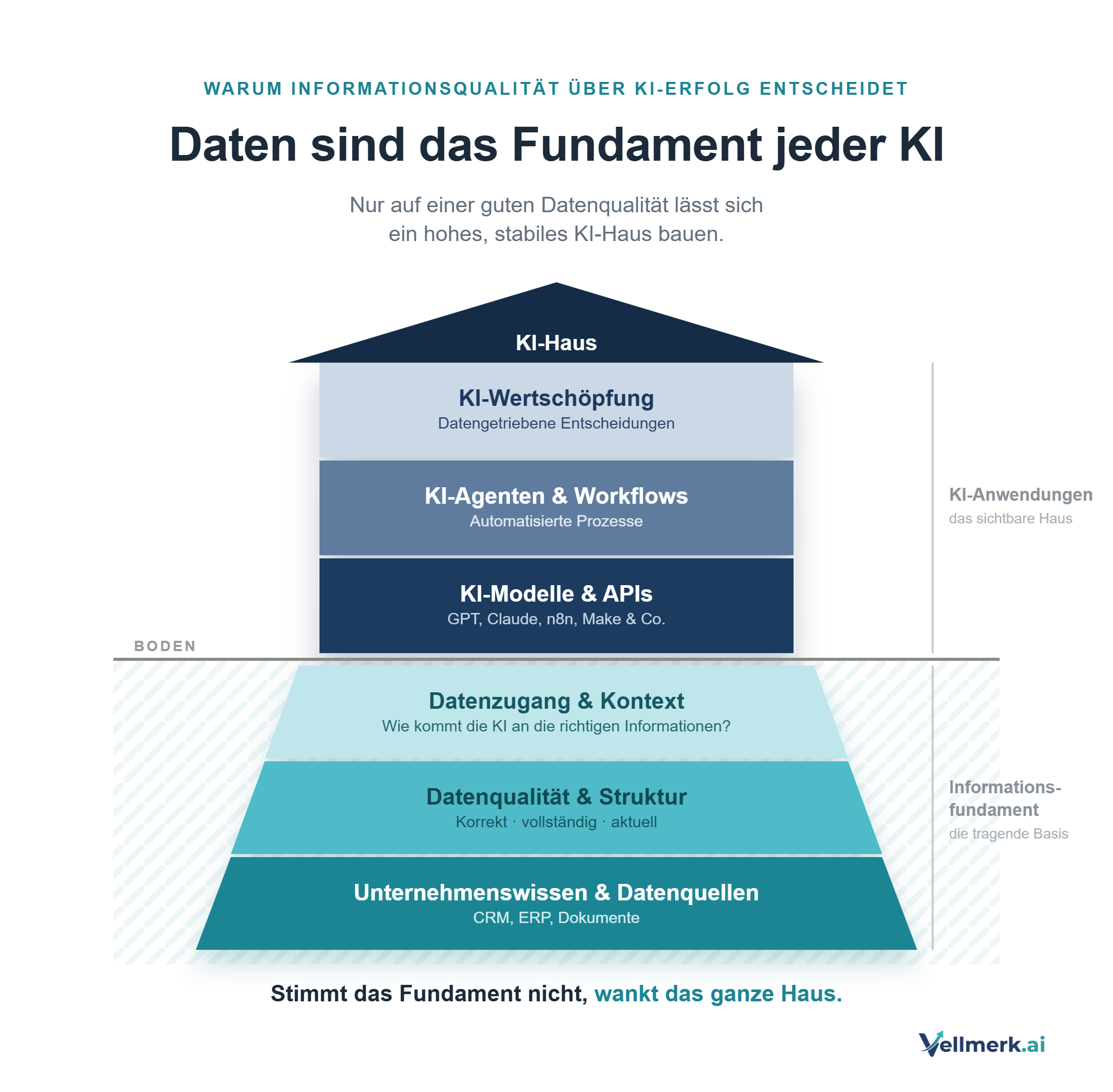
Think of artificial intelligence as a house. Everyone talks about the architecture, the facade, the smart features. But nobody asks: How solid is the foundation? Across multiple client projects, Vellmerk.ai sees the same pattern again and again: most AI projects fail not because of the technology, but because of the information base.
The Information Foundation
What exactly do we mean by foundation? It is everything that an AI has at its disposal to solve a task. In practice, we encounter various terms for this:
Prompt Engineering: the art of asking an AI the right question and providing the right context. Sounds trivial, but it isn't. The difference between a mediocre and an excellent AI response almost always lies in the prompt.
Context Engineering: the next step: not just optimising the question, but systematically shaping the entire information context that the AI receives. Which documents, which rules, which examples are included?
Data Management, when we take yet another step back: How is the company's data structured, maintained, and accessible? Here we're talking about data quality, data architecture, and governance: the basis on which everything else is built.
All these terms fundamentally describe the same thing: different levels of the same information foundation. And all of them need to be right for AI to work reliably.
The Higher the House, the Deeper the Foundation
A simple chatbot that answers FAQs needs a manageable foundation: a clean knowledge base, clear wording, done. But an AI agent that independently manages business processes, makes decisions, and interacts with external systems? That needs a massive foundation.
And here lies the problem: Many companies want the penthouse but have the foundation for a garden shed. The consequences are well known, under various names:
Hallucinations: the AI invents information because it lacks the right data.
Errors in automated processes: the workflow runs, but the results are wrong because the input data is incomplete or outdated.
Inconsistent answers: the same question delivers different results because the context is not reproducible.
These are usually not technology problems. They are data problems.
The Uncomfortable Mirror
Now let's be honest: When we talk about "artificial intelligence," it sounds like an independently thinking entity. But it isn't. What we call AI is, at its core, highly complex stochastic data processing. No consciousness, no intuition, mathematics based on probabilities.
And that means: When the result isn't right, in most cases it's not the computation that's wrong, it's what we fed into it.
"When AI makes mistakes, we need to be honest: Most of the time it's not the AI, it's us. The data we gave it. Or didn't give it."
The old principle of "garbage in, garbage out" is as relevant as ever. The only difference is that the consequences are bigger today, because AI systems are being deployed in increasingly critical processes.
From Foundation to Flying Use Case
The good news: The foundation can be built. In its consulting, Vellmerk.ai therefore doesn't start with the question "Which AI tool should we buy?" but with: "What does your data foundation look like? And what does your use case really need?"
Sometimes it's enough to properly structure existing documents. Sometimes a data architecture overhaul is needed. And sometimes it turns out that the desired use case doesn't fail because of the AI, but because of missing processes upstream.
Figuring out exactly that, which foundation you need so your specific use case can fly, that's what Vellmerk.ai does every day.
"Data is not the new oil. Oil gets burned. Data is the foundation, and on a good foundation, you can build as high as you want."
Conclusion
Before you think about AI tools, agents, or automation: Look at your foundation. Is your data clean, accessible, and complete? Is the context your AI receives really what it needs? Is the basis on which everything is built solid?
If you're not sure, that's exactly what we're here for. Get in touch, and Vellmerk.ai helps you build the right foundation for your AI initiatives.
About Vellmerk.ai
Vellmerk.ai is an AI consultancy (Danish ApS) founded by Thorsten Vellmerk. Drawing on 20+ years of process and IT experience and several years of hands-on AI consulting, Vellmerk.ai helps SMEs and public administration adopt AI in a practical, sovereign way, from strategy to local, on-premise-ready implementation. Proven across multiple client projects. Book an initial consultation.