Put three people at a table and ask them to describe the same process. The process documentation, the manager responsible, and the person who runs the process every day. Only in the rarest of cases do these three describe the same process. Most of the time you get three different ones.
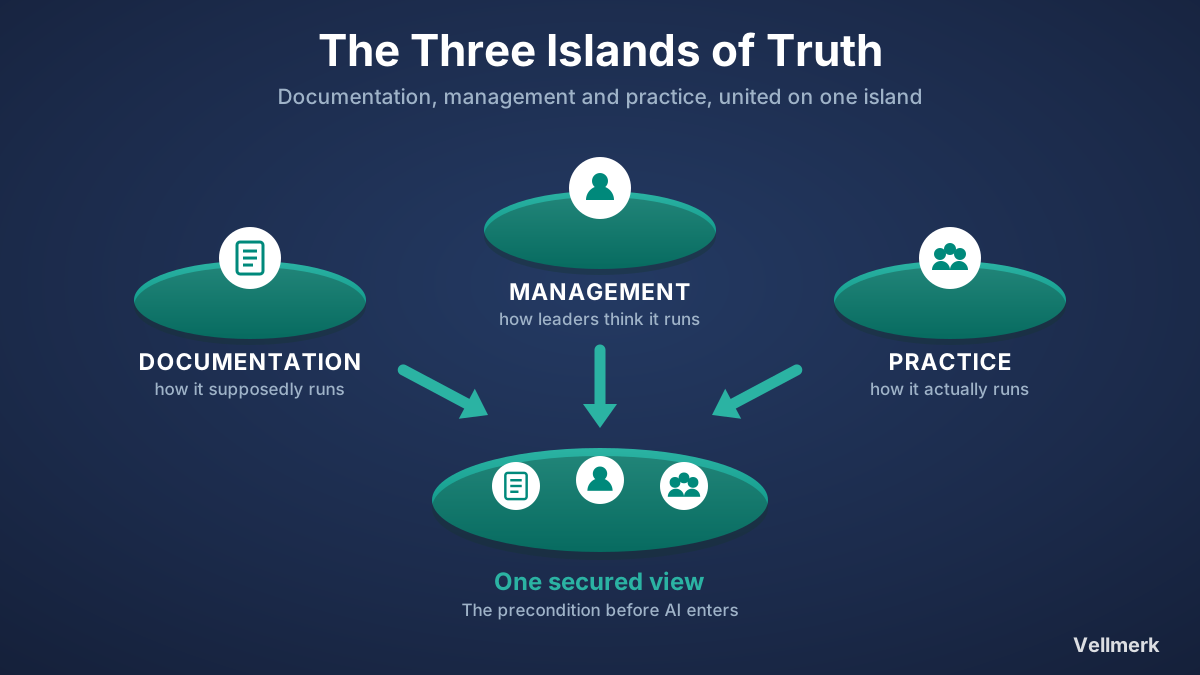
I call this the three islands of truth. And a valuable part of the consulting work begins exactly here: bringing them back together. Entirely without AI, and long before anyone even talks about AI.
The three islands of truth
Island 1: The documented truth. The process as it stands written down, in the quality manual, in the work instruction, in the onboarding document. How it supposedly runs.
Island 2: The perceived truth of management. The process as supervisors believe it is carried out. Often a blend of what was once introduced and what people wish were the case.
Island 3: The lived truth in the process. The process as people actually carry it out day after day. With all the shortcuts, workarounds and quiet arrangements that emerge in real operations, usually for good reason.
Between these three islands often lie years of unspoken drift. And almost no one in the company sees all three at the same time.
Why this is the norm, not the exception
Important for everyone involved: this gap is not a sign of sloppiness. Researchers have known about the phenomenon for decades and has given it names. Documentation also dates quickly: the process moves on, the written document stays put. As an aside, this is exactly where a worthwhile use of AI lies, if only to keep the documentation up to date.
The safety researcher Erik Hollnagel distinguishes between “Work-as-Imagined” and “Work-as-Done”, between the work as planners and supervisors imagine it, and the work as it is actually done. His finding: in complex systems this difference is always present, because everyday operations produce variance.
Even earlier, the organisational researchers Chris Argyris and Donald Schön described the gap between “espoused theory” and “theory-in-use”, between what people say they do and what they really do. Not out of dishonesty, but because lived action follows quiet rules that hardly anyone ever states out loud.
In other words: the fact that your three islands drift apart is to be expected. The real question is not whether it happens, but whether anyone builds the bridges.
Building the bridge, and what that delivers even without AI
This is exactly the work. Once the three islands are on the table, the decisive questions can be asked.
How would we do it if we were starting from a blank sheet? No legacy baggage, no “that is how it has always been”. This perspective breaks mental blocks that stay invisible in day-to-day operations.
What is the actual benefit for each person involved? Every process step exists for someone. Who benefits from what, and from what exactly? Where steps cannot answer this question, they are candidates for removal.
What are the mandatory gates we absolutely have to pass through? Fixed software systems, internal requirements, external obligations, legal rules. Much about the process rightly looks the way it looks. That needs to be cleanly separated from what has merely grown historically.
Out of these questions emerges the real result: a jointly secured view. A process that documentation, management and execution sign off on together for the first time in a long while, as “this is how it is, and this is how it should be”.
That alone is already real value. And time and again I hear the same sentence at exactly this point, from staff and managers alike: “Mr Vellmerk, you should have come years ago.”
And then, only then, comes the AI
Here the circle closes to artificial intelligence. This process clarification is not a nice preliminary step, it is the precondition. Two well-known sentences capture it precisely.
In 2015, Thorsten Dirks, then CEO of Telefónica Germany, coined the by now legendary line:
“If you digitise a shit process, you get a shit digital process.” , Thorsten Dirks, 2015
Years earlier, Bill Gates had described the same mechanics. In “The Road Ahead” (1996) he warned that technology does not improve an operation, it amplifies it:
“Automation applied to an efficient operation will magnify the efficiency. Automation applied to an inefficient operation will magnify the inefficiency.” , Bill Gates, 1996
And it takes little imagination to see that exactly the same holds for AI, only sharper. AI does not merely digitise a bad process, it scales it, around the clock, in every single run. From this we draw our own conclusion:
“To paraphrase Dirks: digitise a bad analogue process and you get a bad digital one. Automate it with AI on top, and you get a bad digital process to the power of ten.” , Thorsten Vellmerk
This is not rhetoric. It is exactly what data quality research has shown for years: automation does not correct errors, it multiplies them. “Garbage in, garbage out” becomes, with AI, “garbage in, garbage at scale”. The damage does not get smaller, it gets larger. A cleanly clarified process is therefore not the optional flourish of an AI rollout, but a hard requirement.
The lasting value
Bringing the three islands together is, at its core, classic management consulting: the client and their processes in focus, analytical, without preconception. No tool, no model, no platform takes this work off your hands. It is the foundation on which everything that follows first becomes viable. And this is exactly where an external perspective is often the decisive lever: internal truths like “that is how it has always been”, which no one inside questions any more, are easier to break open from the outside, through someone who does not know them in the first place, not naive, but without preconceptions, and with the knowledge of what has proven itself in other organisations.
“Most companies think they have an AI problem. In truth they first have a clarity problem. Once the three islands of truth line up, you see very precisely where AI helps, and where it would only have accelerated the mess.” , Thorsten Vellmerk
Anyone who wants to introduce AI should therefore not start with the AI, but with an honest question: do we actually know how our process really runs? This is exactly the question we help with. We bring the experience from many processes, merge your three islands into one secured view, and then also support you in optimising the process, before the first AI ever enters the picture.
Sources and further reading
The Dirks quote in context (Mice Guy): mice-guy.com
Bill Gates on automation, The Road Ahead 1996 (BrainyQuote): brainyquote.com
Bridging the gap between Work-as-Imagined and Work-as-Done (Patient Safety Authority): patientsafety.pa.gov
Argyris and Schön, espoused theory vs theory-in-use (infed.org): infed.org
Garbage in, garbage out and AI (TechTarget): techtarget.com
About Vellmerk.ai
Vellmerk.ai is an AI consultancy (Danish ApS) founded by Thorsten Vellmerk. Drawing on more than 20 years of process and IT experience and several years of hands-on AI consulting, Vellmerk.ai helps SMEs and public administration use AI pragmatically and sovereignly, from strategy to local, on-premise-capable implementation. Proven in several client projects. Book an intro call.