Imagine that one of the most capable tools in your company suddenly becomes unavailable on a Monday morning, without any warning. Not because a server failed. Not because an invoice was unpaid. Not because it has a stomachache. But because a government agency in another country decided it should be so.
That is exactly what happened on 12 June 2026. By official order, access to two of the most powerful AI models was blocked for all users outside the USA, just like that, by a political decision. For many companies that had built their processes on these models, the lights suddenly went out. Admittedly, in this case the model was still fairly young and alternatives were found quickly. But you can recognize the risk behind it all the same.
Maybe you are thinking: nothing here hangs on a single provider that tightly. Maybe that is true (for now). But are you sure? It is exactly at this question that a topic many underestimate moves from the margins to the center: local AI. At Vellmerk.ai, from multiple client projects, it has long been at the center. And not for the reason most people name first.
Local AI Is Sold the Wrong Way
Whenever on-premise AI comes up, the word data protection follows almost reflexively. That is correct and important, especially in public administration, in healthcare, or wherever personal data is involved. But data protection is only half the story.
The real, often overlooked reason is independence. A local model runs on your own infrastructure. No one but you can profit from your data. No one outside your organization can switch it off, raise its price, ration it, or attach conditions to it. Since the decision of 12 June at the latest, this is no longer a fantasy but a real possibility, and therefore a strategic question.
The Decisive Point: No One Can Switch Off a Local Model
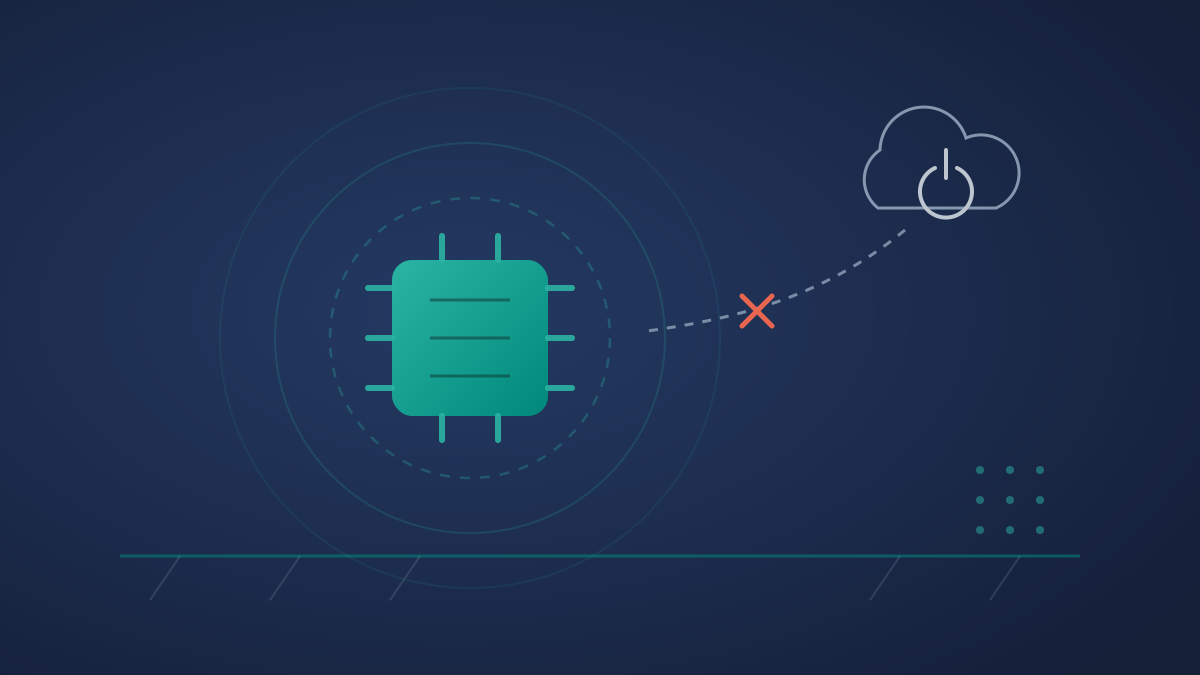
This is the core that many have not yet thought through to the end. A modern, open model, even a Chinese one, can be operated entirely locally. It needs no connection to the internet for that. It can run in a sealed-off environment in which, technically, no information can reach the outside at all.
What does that mean in concrete terms? Even if the provider changes its policy tomorrow, even in the event of a trade war, even if a government blocks official access: your locally running instance keeps working. You have the model, it sits on your hard drive, it computes on your hardware.
Of course, license terms can change, and whether continued operation is permissible in every detail should be examined in a worst-case scenario. But let us be honest here too: operations keep running during that review for the time being. So a local model does not vanish overnight by official order. A cloud API does.
It Is Not About One Model. It Is About Dependency.
Anyone who regards 12 June as an isolated case misjudges the risk behind it. Access to strategic AI has become a pawn of competing interests, and from several sides at once.
The USA uses access as leverage, and not only with models. Since 2022, US export controls have governed which AI chips may be delivered to China and to Chinese firms at all, and these rules change with every administration: sometimes loopholes are closed, sometimes deliveries are permitted again. The same logic applies to entire cloud platforms, the hyperscalers: a sanction or an order can cut off not just a model but many further services on which essential parts of your operation may run.
And China? It is no different, only more subtle. Chinese models have a filter aligned with the state's official line built in: questions about the 1989 Tiananmen massacre are blocked, Taiwan is portrayed as an “inalienable part of China.” And the fact that these models are often made available as open source is probably not out of altruistic motives. Hard-nosed state interests stand behind that too.
This makes the actual principle visible, and it is an old one:
“Nations have no permanent friends, only permanent interests.” (attributed to Lord Palmerston, 1848)
This is not an accusation against any single country but a sober description of how states act. And it applies to all of them. Whoever accepts this draws the only sensible conclusion: not to rely on the goodwill of a single actor or a single state. Because this goodwill is not a reliable constant but a political variable.
At its core, then, this is about uncertainty. No one knows which rule will apply tomorrow, or which provider will be blocked, made more expensive, or politically instrumentalized. This uncertainty cannot be argued away. But you can set up your own capacity to act so that the operation of your own processes does not depend on a single signature. That is precisely the point of local, independent AI.
The Honest Price: More Effort, More Control
At this point, my honest assessment, because of course local AI is not a no-brainer. It means more effort: hardware, hosting, operations, maintenance, your own know-how. A cloud API you simply call, a local model you have to set up and maintain.
But that is exactly the trade-off in question. You give up some convenience and in return gain independence and predictability. For non-critical tasks, the cloud may well remain the right choice. For everything strategic, sensitive, or business-critical, the calculation shifts. Not every task needs the most powerful model, and a great deal runs surprisingly well on reasonable in-house hardware, and even keeps running when the world gets a little more insane.
Data and Architecture as the Moat of the Future
Think further ahead, to the organization of the coming years: people, AI agents, and automated processes working together. In this organization, local elements are hard to imagine away. For one thing, because more and more sensitive data is involved. For another, because your own architectures, built on your own data foundations, become a genuine competitive advantage. Do not underestimate how profoundly the organization of the future will change, and how naturally AI agents and human actors will grow into a symbiosis.
This is precisely where the new moats of the future must be built, the ones that secure your competitive advantage. In part these are smart architectures for your data flows, but also a kind of “safe space” based on local AI. Whoever builds their AI capability on their own foundation, with their own data, their own models, and the ability to run them independently, cannot be held hostage. Whoever rents everything can be.
Not Either-Or: The Hybrid Path
As so often, none of this means you have to bet everything on a single card starting tomorrow. The sensible path is usually hybrid: sensitive and strategic workloads local, the non-critical rest wherever it runs most efficiently, often in the cloud. What matters is that the decision is made deliberately, and that a plan B exists for the worst case, one that does not depend on a single signature in another country.
“Sovereignty is no longer a nice-to-have. It is the precondition for AI to remain reliably predictable for your company. And the good news is: we can already act on our own responsibility today.”, Thorsten Vellmerk
What a First Step Looks Like
So you do not have to rebuild your entire AI setup tomorrow. But you should know where you are vulnerable today and which workloads can be secured locally. That is exactly what Vellmerk.ai looks at with you: which data and processes belong in an independent, on-premise-capable environment, and where the cloud is sufficient? In a no-obligation initial conversation, Vellmerk.ai identifies the right starting points for your sovereignty with you.
Sources
Anthropic: Statement on the suspension of access to Fable 5 and Mythos 5, 12 June 2026. anthropic.com/news/fable-mythos-access
US export controls on AI chips, including for Chinese firms outside China: Al Jazeera, 2026. aljazeera.com
Built-in censorship in Chinese models (DeepSeek, Tiananmen, Taiwan): Voice of America. voanews.com
About Vellmerk.ai
Vellmerk.ai is an AI consultancy (Danish ApS) founded by Thorsten Vellmerk. Drawing on 20+ years of process and IT experience and several years of hands-on AI consulting, Vellmerk.ai helps SMEs and public administration adopt AI in a practical, sovereign way, from strategy to local, on-premise-ready implementation. Proven across multiple client projects. Book an initial consultation.