Anyone who has ever planned an AI project knows the problem: effort estimation is a gamble. Vellmerk.ai works with state-of-the-art models whose capabilities change every few months. APIs that work today may be deprecated tomorrow. And then there's the data foundation that looked perfect in theory, until you actually look at it.
The requirements? Often unclear, because the client doesn't yet know what's possible with AI. The effort estimation? At best, an educated guess.
The impact, however, we can usually assess very well.
The Vellmerk Matrix
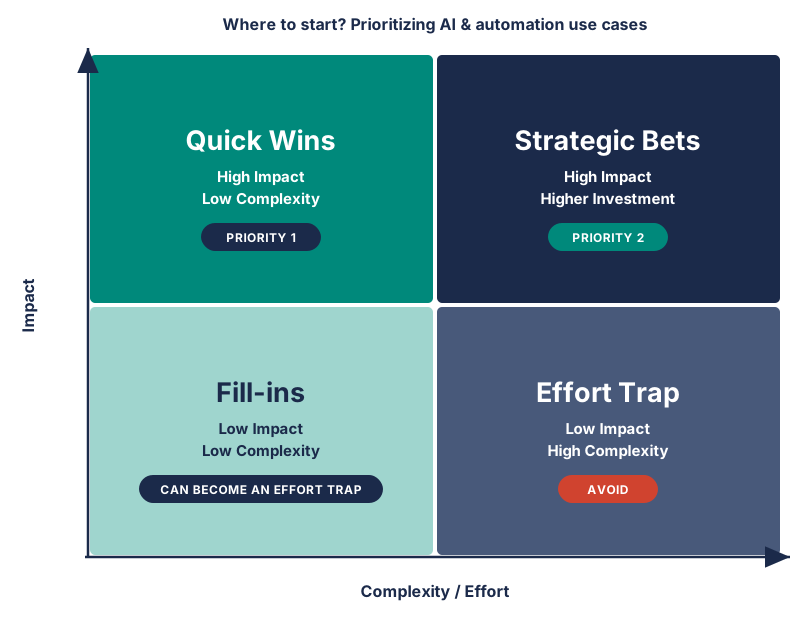
The Vellmerk Matrix is a simple 2x2 framework that Vellmerk.ai uses in consulting, refined across multiple client projects, to prioritise AI projects. The two axes:
Y-axis: Impact, How significant is the business value? This can usually be assessed well: time savings, error reduction, customer satisfaction, revenue potential.
X-axis: Effort (uncertain!), How much work will it take? And here's the crux: in AI projects, this estimate is notoriously unreliable.
The Four Quadrants
Quick Wins (high impact, low effort): The sweet spot. This is where we love to start. Quickly visible results that motivate the team and build trust in the use of AI.
Strategic Bets (high impact, high effort): Complex projects with great potential. Even if the effort increases: the high impact justifies the investment. If you misjudge the effort here, you've still built something valuable.
Fill-Ins (low impact, low effort): Nice optimisations that you can pick up along the way, but never as a starting point. Because if the effort unexpectedly increases (and it does), you're stuck with a costly project that creates little value.
Time Wasters (low impact, high effort): Stay away. In the context of AI projects, the most dangerous category, and exactly where you end up if you start with Fill-Ins and the effort estimation misses the mark.
The Golden Rule: Stay in the Top Row
The central insight of the Vellmerk Matrix: Always start in the top row, with Quick Wins or Strategic Bets. Both have high impact.
Why? Because effort estimation in AI projects is uncertain by definition. If you start at the top and the effort turns out higher than expected, your project moves from Quick Win to Strategic Bet. That's okay: the impact is still high, it's still worth continuing.
But if you start at the bottom, with Fill-Ins, and the effort explodes, you land in the worst quadrant: Time Wasters. A lot of work, little value. And that is exactly the effort trap that can be avoided.
"Impact is the compass, effort is just the weather. And weather changes."
Conclusion
The Vellmerk Matrix is not an academic model, it is a pragmatic tool that Vellmerk.ai uses in every consulting project. It helps prioritise the right projects and avoid the typical pitfalls in AI implementations.
Want to apply the Vellmerk Matrix to your projects? Get in touch, Vellmerk.ai helps you find the Quick Wins and avoid the Time Wasters.
About Vellmerk.ai
Vellmerk.ai is an AI consultancy (Danish ApS) founded by Thorsten Vellmerk. Drawing on 20+ years of process and IT experience and several years of hands-on AI consulting, Vellmerk.ai helps SMEs and public administration adopt AI in a practical, sovereign way, from strategy to local, on-premise-ready implementation. Proven across multiple client projects. Book an initial consultation.