I have been advising on artificial intelligence since 2022, so for a good four years now. Two conversations from that time have stayed with me in particular, and I tell them as representative of many. Both come from public administration.
In the first, the brief was, roughly, that they now needed something with AI as well. The neighbouring municipality had one of those chatbots on its homepage, and they would like one too. A problem that was supposed to be solved never came up in the conversation.
I have yet to see a company that became better because of a chatbot on its home page. But I have seen several organisations that afterwards believed the AI question had been settled.
In the second, we had talked about models, architectures and automated workflows, with and without AI. Then came the objection that nobody yet knew which model would win in the end. Better to wait until that had been settled, in about three years.
The third pattern I see less often in administrations and more often in companies. Considerable money flows into a use case where a rough calculation at the start would have shown that it does not pay off. Not even if everything works exactly as planned.
At first glance the three cases have little in common. In none of them was the technology the problem.
What was missing each time was the work that comes before. There was no properly defined business case, and there was no order of priority based on which application brings the greatest benefit. For exactly that order I use a simple map, the Vellmerk Matrix, which sorts projects by impact and effort.
I am not alone in this. It matches what I hear from other consultants and from clients who previously worked with someone else. They add stories that point in the same direction. A pilot that never went live. A model trained on data nobody maintained. A solution that worked technically and sat at the point in the process where it helped nobody.
This is anecdotal, and I do not want to pass it off as more. When I read up on what the research says, it surprised me on two points, and in both cases not in the direction I had expected.
The industry's most quoted figure does not hold up
Since summer 2025 one figure has been haunting every presentation: 95 per cent of all GenAI pilots supposedly deliver no return. It comes from a paper by MIT's Project NANDA from July 2025, 26 pages, subtitled “Preliminary Findings”. Behind it are 153 completed questionnaires, 52 interviews and a review of publicly documented initiatives, gathered at four industry conferences within a window of six months.
Kevin Werbach of the Wharton School has publicly admitted that he cannot find the figure in the document: “I've read through the document multiple times, and I still can't understand where it comes from.” The report is not peer reviewed, and it counts every pilot that does not reach full operation within six months as a failure. Some of them were never meant for production; they were learning exercises and vendor comparisons.
I am not saying this to gloss over the industry. I am saying it because an article about mistakes in AI adoption can hardly begin by passing on an unverified figure itself.
The figure that counts instead
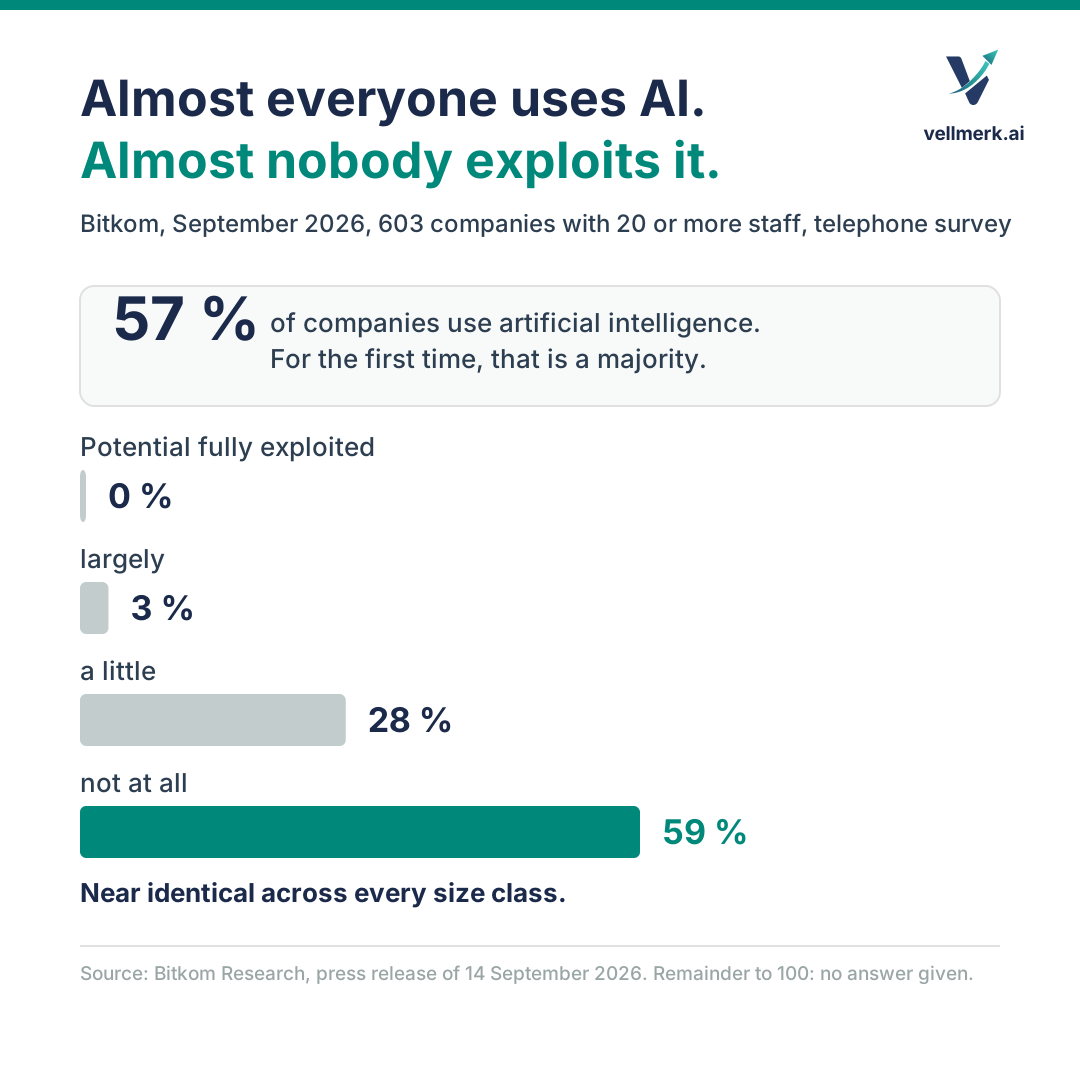
In September 2026 Bitkom, the German digital industry association, surveyed 603 companies with 20 or more employees by telephone. 57 per cent use AI, the first time a majority does. 45 per cent of users report a measurable contribution to business success. The claim that AI fails across the board lags behind the data.
It gets interesting two questions later in the same survey. Asked how far they exploit the potential of AI in their own organisation, not a single company answers fully. 59 per cent answer not at all, and there is hardly any difference between size classes.
So the tools are there, and still they move almost nothing. Perhaps because they are the wrong ones, perhaps because they are being used wrongly.
 AI-generated
Individuals get faster, the organisation stands still
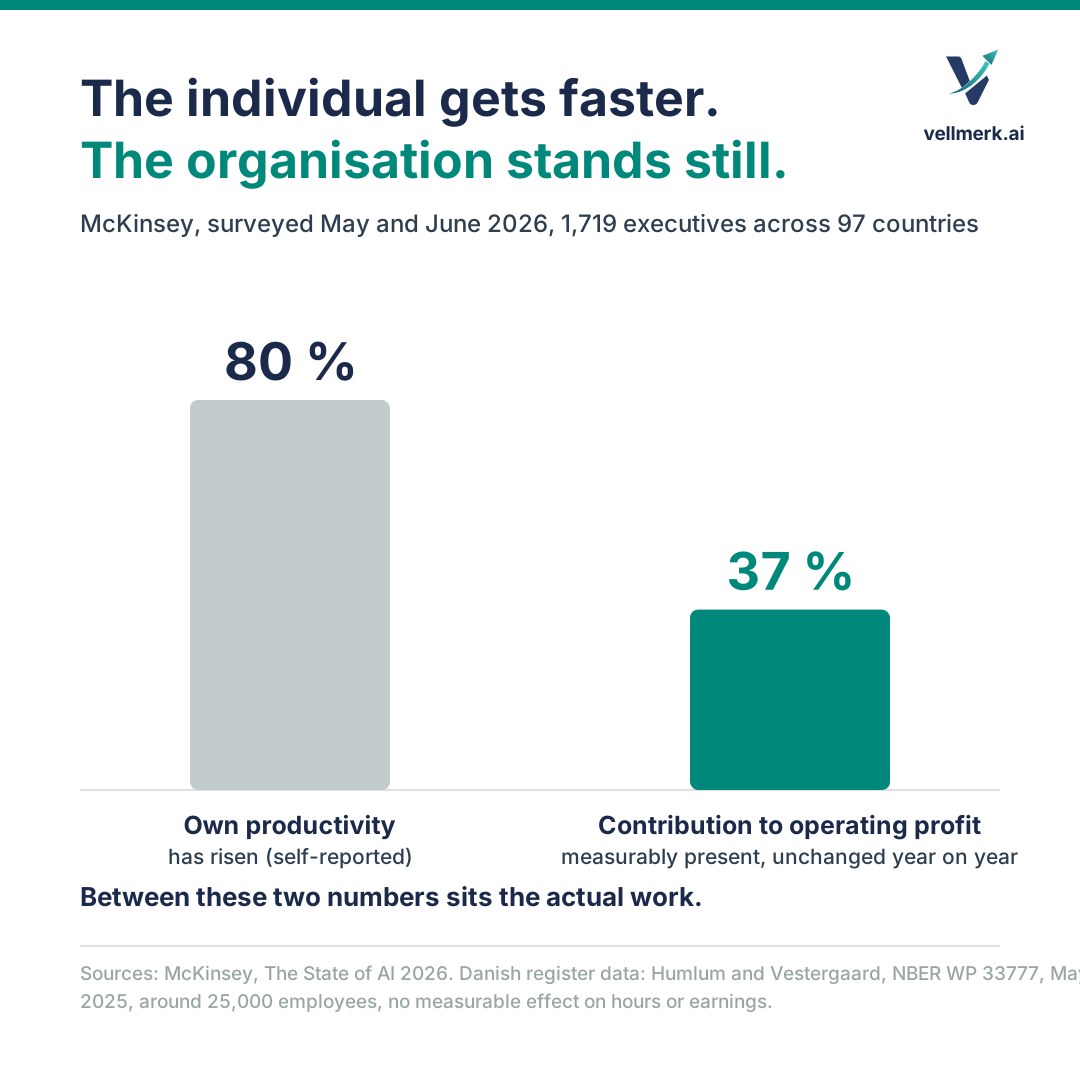
McKinsey arrives at the same picture on a larger scale, having surveyed 1,719 executives in 97 countries in May and June 2026. 80 per cent report that their own productivity has risen. 37 per cent see a contribution to operating profit, unchanged from the previous year.
The hardest evidence comes from a Danish study, and it is hard precisely because it does not rely on self-reporting. For an NBER working paper from May 2025, Humlum and Vestergaard analysed register data on around 25,000 workers at 7,000 workplaces in eleven occupations. AI chatbots had no significant effect on earnings or hours worked. The authors rule out effects larger than two per cent after two years.
This result is often read as proof that AI does not work. That is not what the paper says. Two quantities from the official registers were measured, earnings and recorded working hours, and neither moves after two years. The authors themselves write that employers absorb the technology by reallocating tasks, and that technological change reshapes work long before it becomes visible in wages or hours.
For this article, that is the more interesting statement. The pay slip is the last place the effect shows. Everything this article is about comes before it: who takes on which task, which data is fit for it, who checks the result. What has been shown is only that after two years none of this had reached earnings.
 AI-generated
It is not the AI that fails
In 2024 the RAND Corporation asked sixty-five data scientists and engineers with at least five years of experience why AI projects fail. The most common cause is not technical: “stakeholders often misunderstand or miscommunicate the problem that AI needs to solve”. Further down the list come missing data, a fixation on the latest technology instead of the users' problem, and infrastructure that cannot support operations.
These are the same reasons a warehouse management project or a document management rollout fails. My experience matches this fairly closely.
An AI project fails because of the same things as any other project: unclear goals, poor data, inadequate preparation or missing information, and unresolved responsibilities. The only special thing about AI is that you can mistake the failure for a technical problem, even though it is not one.
The four patterns I see most often
The tool is chosen before the problem
The chatbot is the reflex solution because it is visible. According to a Bitkom survey, 88 per cent of AI users deploy the technology in customer contact. Internal knowledge management, where the leverage is often greater, comes to 11 per cent. On average a company has exactly two AI applications, and a quarter has exactly one.
The same NANDA paper that contains the questionable 95 per cent has, elsewhere, a finding I consider the most useful in the whole document. Between 50 and 70 per cent of GenAI budgets go to marketing and sales, even though back-office automation usually delivers the better return. The authors' explanation: this reflects not value but how easily metrics can be attributed.
The data cannot carry the load
In July 2024 Gartner surveyed 1,203 data management leaders. 63 per cent had no practices, or no reliable ones, for AI-ready data. The resulting forecast: 60 per cent of projects without such data will be abandoned by the end of 2026. A survey of around 600 data leaders in January 2026 reaches the same conclusion; there, 91 per cent name data reliability as a brake on the way from pilot to production.
At Bitkom, 50 per cent of companies name data preparation as a major cost item, as many as name infrastructure. Why that is, and what should be clarified beforehand, I have described in more detail in Data Is Not the New Oil and in The Three Islands of Truth.
The pilot never goes live
At the end of 2024 Deloitte surveyed 2,773 executives in 14 countries. 68 per cent had moved 30 per cent or fewer of their GenAI experiments into production, only 5 per cent more than 70 per cent. In the follow-up survey of January 2026, 25 per cent say they have managed at least 40 per cent. The figures vary widely because pilot, experiment and proof of concept mean something different in every study.
The direction is clear all the same, and it is old. McKinsey described the phenomenon back in 2018 for Industry 4.0 and called it “pilot purgatory”. At the time 92 per cent of respondents felt on a par with their competitors, while 30 per cent had scaled.
The organisation does not learn with it
I consider this pattern the most consequential. In the Deloitte survey of January 2026, 84 per cent say they have not redesigned a single role since introducing AI. Of those with access to AI tools, fewer than 60 per cent use them day to day. At McKinsey, around three quarters of the few companies with a notable contribution to earnings had fundamentally redesigned their workflows; among all the others it was around a quarter.
This is the point at which a tool purchase becomes a change, or does not. A model placed into an unchanged process speeds up that process and nothing else.
Why absorptive capacity matters more than technology
There is an older and fairly precise term for what is missing here. In 1990, in Administrative Science Quarterly, Wesley Cohen and Daniel Levinthal described absorptive capacity, an organisation's ability to recognise the value of external knowledge, assimilate it and apply it. Their finding: this ability depends on knowledge already present; it is cumulative and path dependent. You cannot buy it and you cannot skip it.
It follows directly why a good service provider alone is not enough. The provider brings external knowledge. Whether the organisation can absorb it is decided inside the organisation. And it explains why the leap from zero to a hundred rarely succeeds: the first, simple applications are not only a return in themselves, they are the precondition for being able to judge the next ones.
In 1990, the same year, Peter Senge described the learning organisation and called systems thinking the discipline that integrates the others. Of his five disciplines, this one above all carries our problem, and it carries it very well: local optimisation amid global stagnation is exactly the pattern the figures above describe. It should be said that Senge's model is normative and has never been tested empirically. The idea only becomes robust through its neighbouring concepts.
For a long time, and wrongly, knowledge management was considered a soft topic. With artificial intelligence it becomes all the more a precondition for creating value and securing competitive advantage.
What speaks against my thesis
Three findings from the same research go against what I am writing here, and I consider them important enough to mention.
External providers apparently deliver better than in-house builds. In the NANDA survey, 67 per cent of successful solutions came from outside and 33 per cent from internal development, and projects from partnerships reached production twice as often. That does not surprise me, and frankly it ought to be so. I earn my living doing exactly this, and it would be a bad sign if experienced service providers delivered worse results on average than an organisation setting up an AI project for the first time. The figure does not say, however, that in-house knowledge becomes dispensable. A company that only buys ends up with a solution it can neither assess nor develop further.
Nor is the chatbot wrong per se. In the Quarterly Journal of Economics in 2025, Brynjolfsson, Li and Raymond analysed the work of 5,172 support agents and measured 15 per cent more cases resolved per hour, and 34 per cent among new hires. As an assistant within the workflow it does carry its weight. As a replacement for people, or as a mere shop window on the home page, mostly not.
And consultancies fail just the same. According to a General Assembly survey from March 2026, 73 per cent of the consulting firms asked had abandoned their own AI projects, mostly because of missing skills. I would draw a different conclusion from this than the obvious one, though, because with a new technology an abandoned project is not a failure per se. Recognising early that the goal cannot be reached at the hoped-for quality, and then deploying the resources differently, is sound work. That is exactly how I set up my own projects. We get to a proof of concept quickly, and if it turns out that we probably will not achieve what we hoped for even with far more effort, we reallocate the resources. Failure only becomes expensive when it comes late.
How to recognise a viable project
Three questions have proved to be the most useful filter for me. Together they take half an hour and occasionally save half a year. I explain them using an example that comes up in administrations and companies alike: incoming invoices are to be pre-checked with AI.
First, what gets better, and how would you notice?
The weak answer is that invoice checking will become more efficient. The useful one is that an invoice currently takes four days on average to be approved and should in future be through in one day. Only with today's value can you later establish whether the project achieved anything. Surprisingly few have it: at McKinsey, only about a fifth of companies had any defined way of measuring the impact of AI.
Second, who works differently afterwards?
In the example, that would be the clerk in accounts payable who in future only checks the invoices the system flags as unusual, and who answers for approving the rest. If no such person with a changed task can be named, no process is being changed; a tool is being bought. That is the most common case. In the Deloitte survey of January 2026, 84 per cent of companies had not redesigned a single role after introducing AI. People got a new tool, and their tasks and responsibilities stayed the same.
Third, what data does it need, and who owns it?
To check an invoice, the system needs three things: the invoice itself, the purchase order it belongs to, and the agreed prices. The purchase orders usually sit cleanly in the ERP system. The agreed prices, by contrast, are often in PDF contracts, in old emails or in the head of a single buyer. Then the project ends before the first line of code is written. And if nobody maintains this data continuously, even a system that starts out well will deliver wrong results after a few months. That is why this question settles so quickly whether a project is realistic this year. You only have to ask, for each of the three things, where it lives and who is responsible for it.
For the order in which to tackle such projects, the Vellmerk Matrix helps by sorting them by impact and effort. And before you deploy a model, it is worth checking whether it needs AI at all or whether a simple rule solves the problem more cheaply.
If you need a second opinion
Much of this can be settled in-house. Sometimes the experience with AI projects is simply missing because these are the first, and that is exactly where an outside second opinion pays off.
We do not only build solutions ourselves, we also work as a sparring partner. The actual building can then stay with your team or with your existing provider, and we take care of quality assurance. We help with planning, with fitting the work into your strategy and with the factors that are easy to overlook in day-to-day business.
What that looks like can be tailored in very different ways. You can bring us in for strategy alone. You can have us assess a provider's offer or concept before you sign, or have a running project reviewed for clarity of goals, data situation and operational readiness. You can give your own developers someone to talk design decisions through with, or hand project management over to us.
Our quality management is certified to ISO 9001, and we run it with AI support ourselves. That is no seal of quality for AI projects, but it does mean we are used to the auditor's perspective. If you need someone at any of these points, get in touch. The first conversation is usually enough to tell whether the effort is worthwhile.
Sources and further reading
- MIT Project NANDA: The GenAI Divide, State of AI in Business 2025, July 2025
- Futuriom: critique of the NANDA study, 26 August 2025
- Bitkom: Erstmals nutzt die Mehrheit der Unternehmen KI (press release), 14 September 2026
- Bitkom study report Künstliche Intelligenz, February 2026
- Humlum and Vestergaard: Large Language Models, Small Labor Market Effects, NBER Working Paper 33777
- RAND: The Root Causes of Failure for Artificial Intelligence Projects, August 2024
- Gartner: Lack of AI-Ready Data Puts AI Projects at Risk, 26 February 2025
- Brynjolfsson, Li and Raymond: Generative AI at Work, NBER Working Paper 31161
- Cohen and Levinthal: Absorptive Capacity, Administrative Science Quarterly 35(1), 1990
- Austrian Court of Audit (Rechnungshof Österreich): KI in der Bundesverwaltung, Reihe Bund 2025/20